


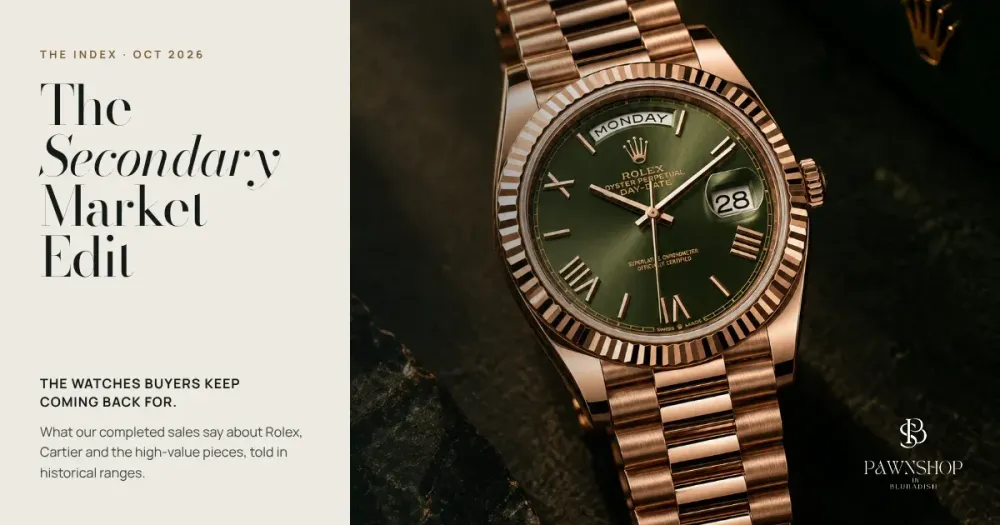
An analysis of over 650 luxury-watch sales by Pawnshop by Bluradish reveals which watches buyers consistently return for, and what those patterns mean for anyone considering a luxury watch as a store of value.
There is a question I think more people should ask before spending $10,000 to $20,000 on a luxury watch.
If I needed to sell this six months from now, who would buy it?
Not how much it costs at the boutique. Not what someone on Instagram says it is worth. Not even what another dealer has listed it for. Who is actually willing to pay for it, and how much?
It is a question that tends to come up too late. Usually when someone needs liquidity, wants to upgrade to another reference, or simply decides that a watch no longer fits their lifestyle. By then, the purchase has been made, and the market gets to determine how much of that money can be recovered.
I have always found this interesting because the luxury-watch industry spends an enormous amount of time discussing craftsmanship, prestige and exclusivity, but considerably less time helping buyers understand what happens financially after ownership. And the difference can be substantial.
A watch can be desirable without being particularly liquid. It can be expensive without retaining much of its original purchase price. Equally, a relatively accessible watch can attract a remarkably consistent pool of secondary-market buyers.
To understand what this looks like in Nigeria, we examined our own transaction history at Pawnshop by Bluradish. Between October 2023 and August 2026, our records captured over 650 luxury-watch sales worth between $7.5 million and $8 million. Rolex, Cartier, Audemars Piguet, Patek Philippe, Hublot and several other watchmakers appeared across those transactions.
What we wanted to understand was straightforward: which watches were people actually buying, which references repeatedly found buyers, and what could those patterns teach someone looking to purchase a watch with resale value in mind?
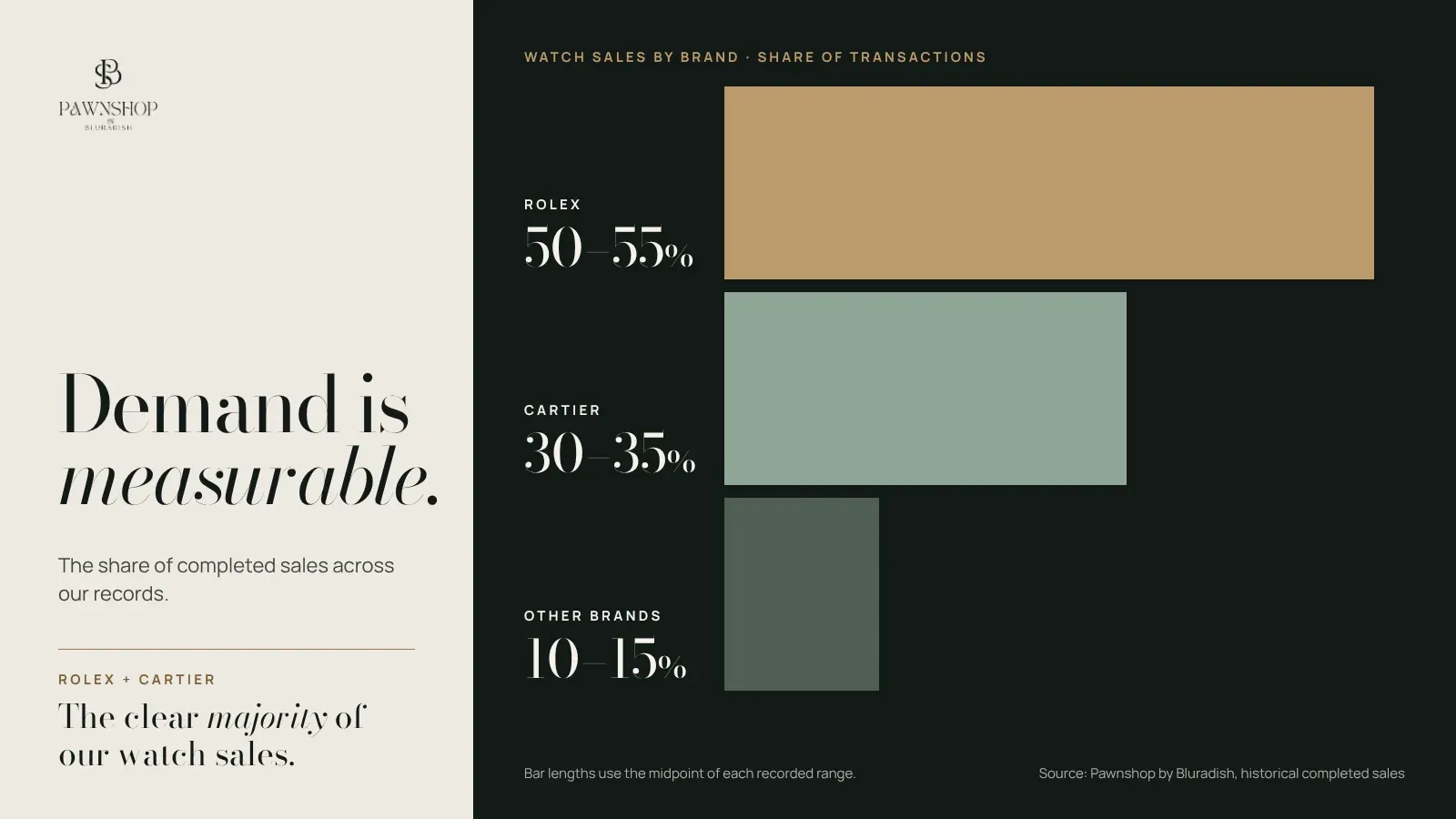
Rolex accounted for approximately 50–55% of watch sales in our records, followed by Cartier at 30–35%. Data covers completed transactions between October 2023 and August 2026. The results pointed to a more interesting conclusion than simply buying the most expensive watch one can afford.
Rolex has the deepest secondary market in our records
Of the watch sales we examined, more than 330 were Rolex transactions, representing approximately 50% to 55% of the recorded sales by number. Those transactions accounted for between $5 million and $5.5 million in sales value, with a median selling price in the $13,000 to $15,000 range.
What struck me was not merely the size of that number. It was how frequently Rolex appeared across different price categories. We were selling Rolex watches around $10,000 to $15,000, while other configurations were changing hands for $35,000 to $55,000 and above.
That range matters because a functioning secondary market needs more than a handful of wealthy collectors. It benefits from buyers at different financial levels, with different preferences and reasons for purchasing.
The Datejust is particularly revealing. Across our records, we identified more than 50 Rolex Datejust sales, generating between $750,000 and $800,000. The median completed transaction was in the $13,000 to $14,000 range.
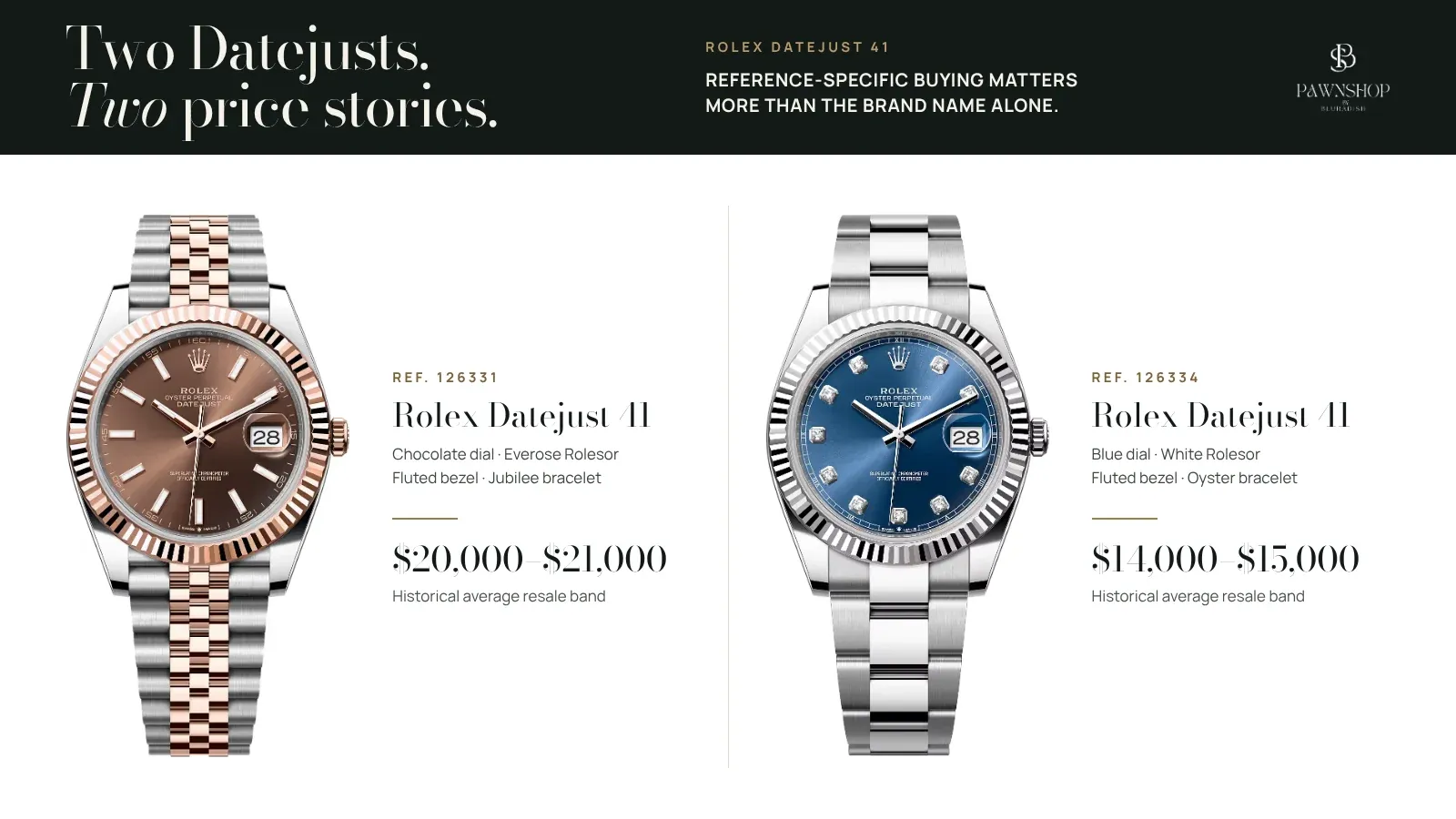
Rolex Datejust 41 references 126331 and 126334 demonstrated recurring demand at different price levels, highlighting how metal, dial and configuration influence secondary-market valuations. That makes the Datejust one of the clearest examples of repeat demand within our identifiable model-level data.
Our more detailed purchase-to-sale records provide additional evidence. Nine transactions involving reference 126331 produced an average resale price in the $20,000 to $21,000 range. Another six involving reference 126334 averaged between $14,000 and $15,000.
These are not interchangeable watches, of course. The 126331 and 126334 differ in their metal configurations, and the dials, bracelets and individual conditions vary. But that is precisely the point. Buying a Rolex is not enough. Choosing the right Rolex is where the financial decision begins.
For someone considering a Datejust as a watch they may eventually resell, our records suggest paying particular attention to established references such as the 126331 and 126334, while assessing the exact dial, bracelet, condition and asking price against recent completed transactions.
The evidence is consistent enough to put these references on a serious buyer's shortlist. It does not, however, mean that purchasing one at any price is a good investment.
The Cartier Santos is a more serious liquidity contender than many buyers realise
Cartier produced the second-largest transaction count in our records, with more than 220 sales. That was less surprising than what the Santos data revealed when we looked at it more closely.
We sold nearly 50 Cartier Santos watches, generating between $290,000 and $300,000 in sales. Our records also show how quickly these watches found buyers, with some selling within just a few days.
The median selling price was between $6,000 and $6,500. More interestingly, across 25 purchase-to-sale transactions, the median time between acquisition and resale was approximately one to two weeks.
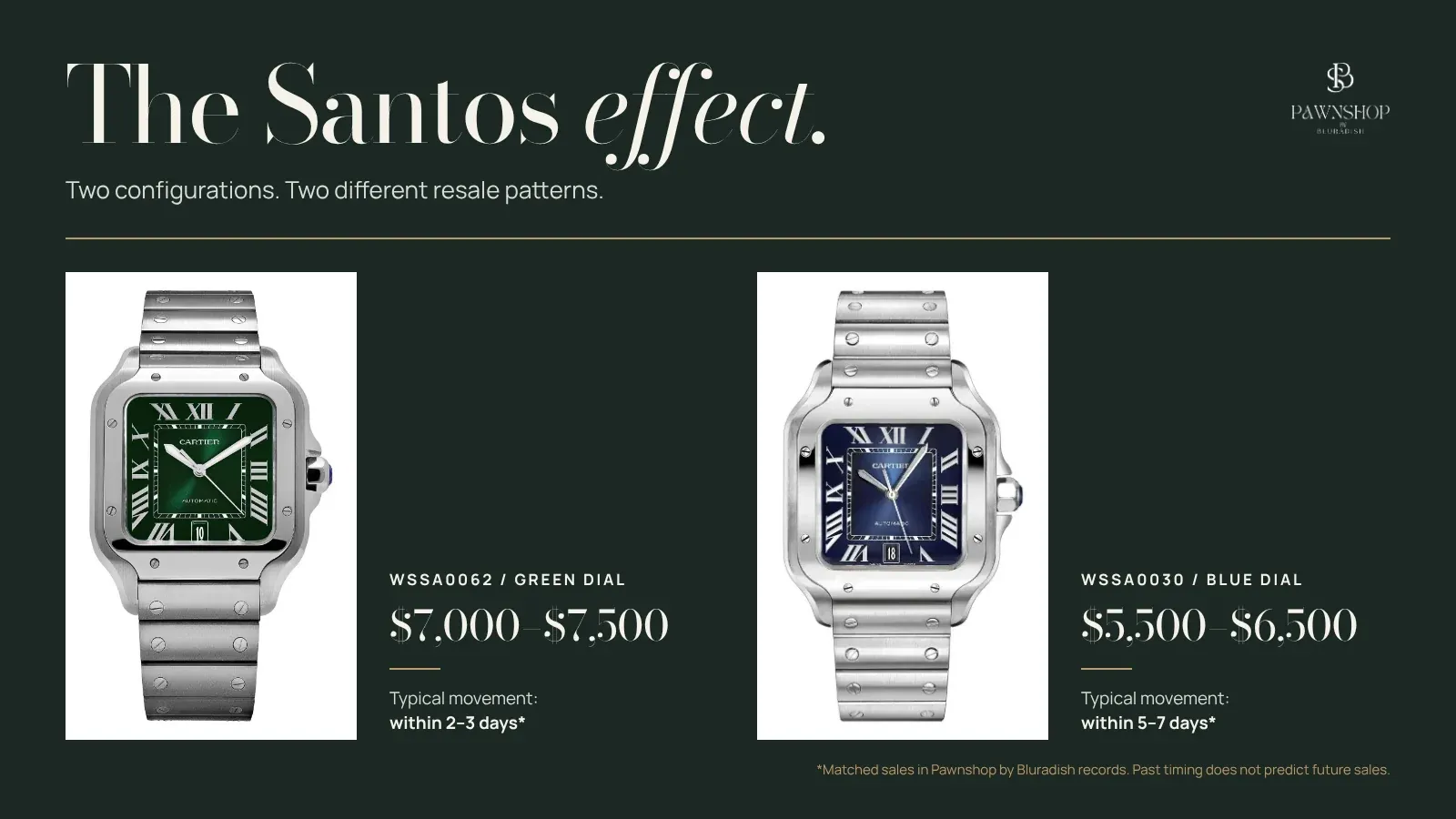
The Cartier Santos WSSA0062 and WSSA0030 demonstrated consistent buyer interest, with several recorded transactions moving from acquisition to resale within days.
Think about what that means operationally. A dealer acquires a luxury watch, places it into inventory and finds a buyer. In several cases, that process takes days rather than months. That does not establish how quickly every private owner could sell the same watch. Dealer networks, acquisition prices, distribution and existing buyer relationships all influence turnover. But it does provide direct evidence that certain Santos configurations were attracting buyers consistently within our business.
The green-dial Santos, reference WSSA0062, was particularly interesting. Across five transactions, its median selling price fell between $7,000 and $7,500. The median holding period was within two to three days. Another configuration, reference WSSA0030, appeared in nine transactions, with a median selling price in the $5,500 to $6,500 range and a median holding period of approximately five to seven days.
The difference tells us something important about the secondary market. Demand does not attach equally to every watch carrying the same brand name, or even to every variation of the same collection. This is also consistent with wider changes in international watch buying. Chrono24's 2025 secondary-market research identified growing interest in Cartier and design-led watches, particularly among younger buyers.
For someone with a budget around $6,000 to $8,000, the Santos deserves consideration beyond its aesthetic qualities. It is elegant enough to be worn daily, but our records also show repeated demand for several configurations. That combination is worth understanding before spending considerably more on a watch simply because it carries a different brand name.
The Day-Date demonstrates why higher prices require a different approach
One of the most expensive Rolex transactions in our records involved a 2024 Day-Date Olive Green, reference 228235, which sold within the $55,000 to $60,000 range. Across seven selected Day-Date transactions, the median selling price fell between $50,000 and $55,000.
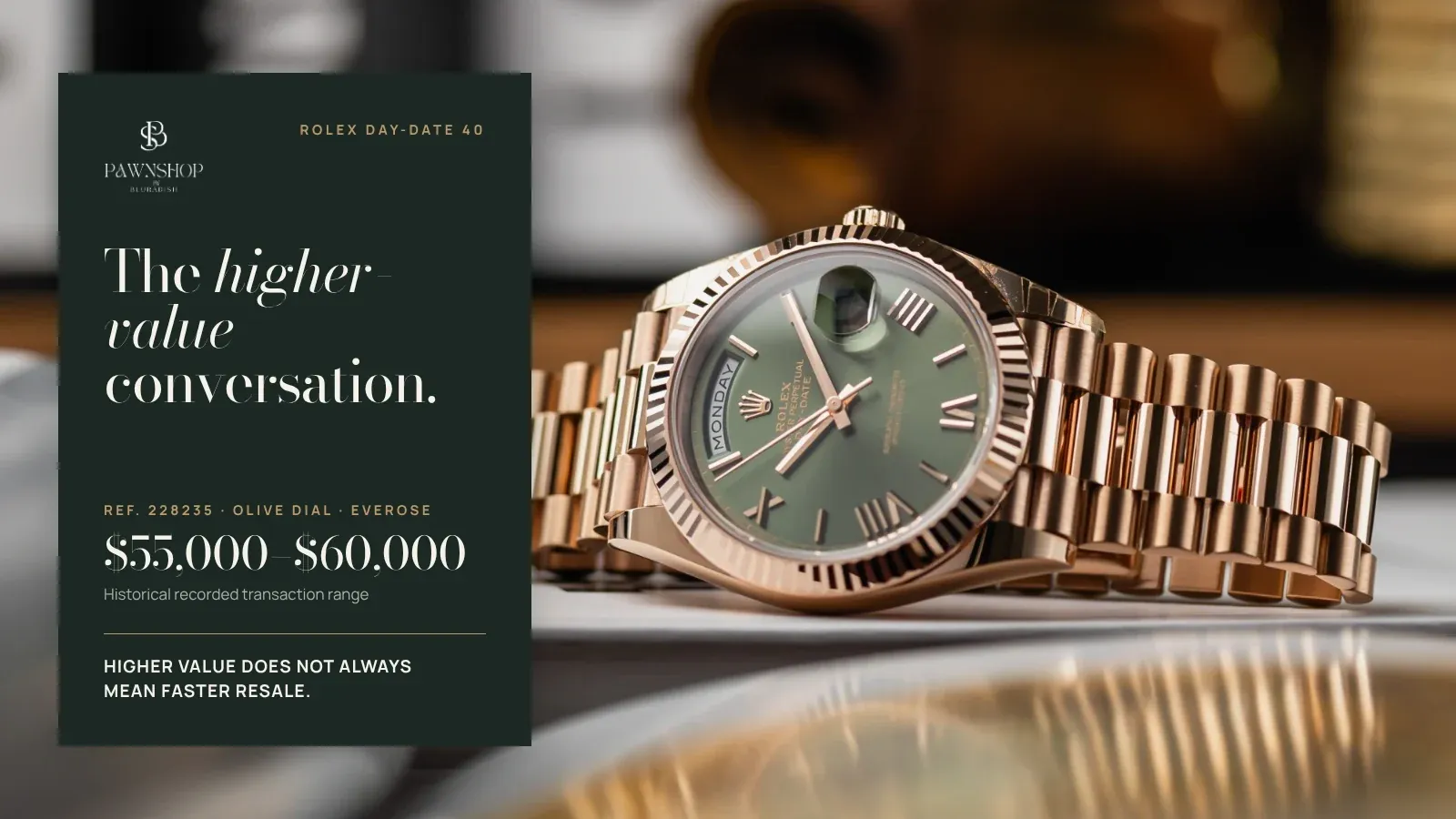
The Rolex Day-Date commands significantly higher transaction values than the Datejust. However, a higher selling price does not necessarily translate into greater liquidity.
Compare that with the Datejust's median selling price of approximately $13,000 to $14,000. The difference is significant, but it would be a mistake to interpret the higher value as evidence of superior liquidity.
A $50,000 to $55,000 watch requires a different buyer from a $10,000 to $15,000 watch. The financial capacity, preferences and purchasing considerations are not the same. Someone considering a Day-Date therefore needs to think beyond the prestige of the collection. Which metal? Which dial? Which reference? At what purchase price? And how much actual secondary-market demand exists for that particular configuration?
The same reasoning applies to watches from Audemars Piguet and Patek Philippe. Our highest recorded Audemars Piguet transaction fell between $125,000 and $130,000, while one Patek Philippe Aquanaut 5167A-001 sold within the $80,000 to $85,000 range.
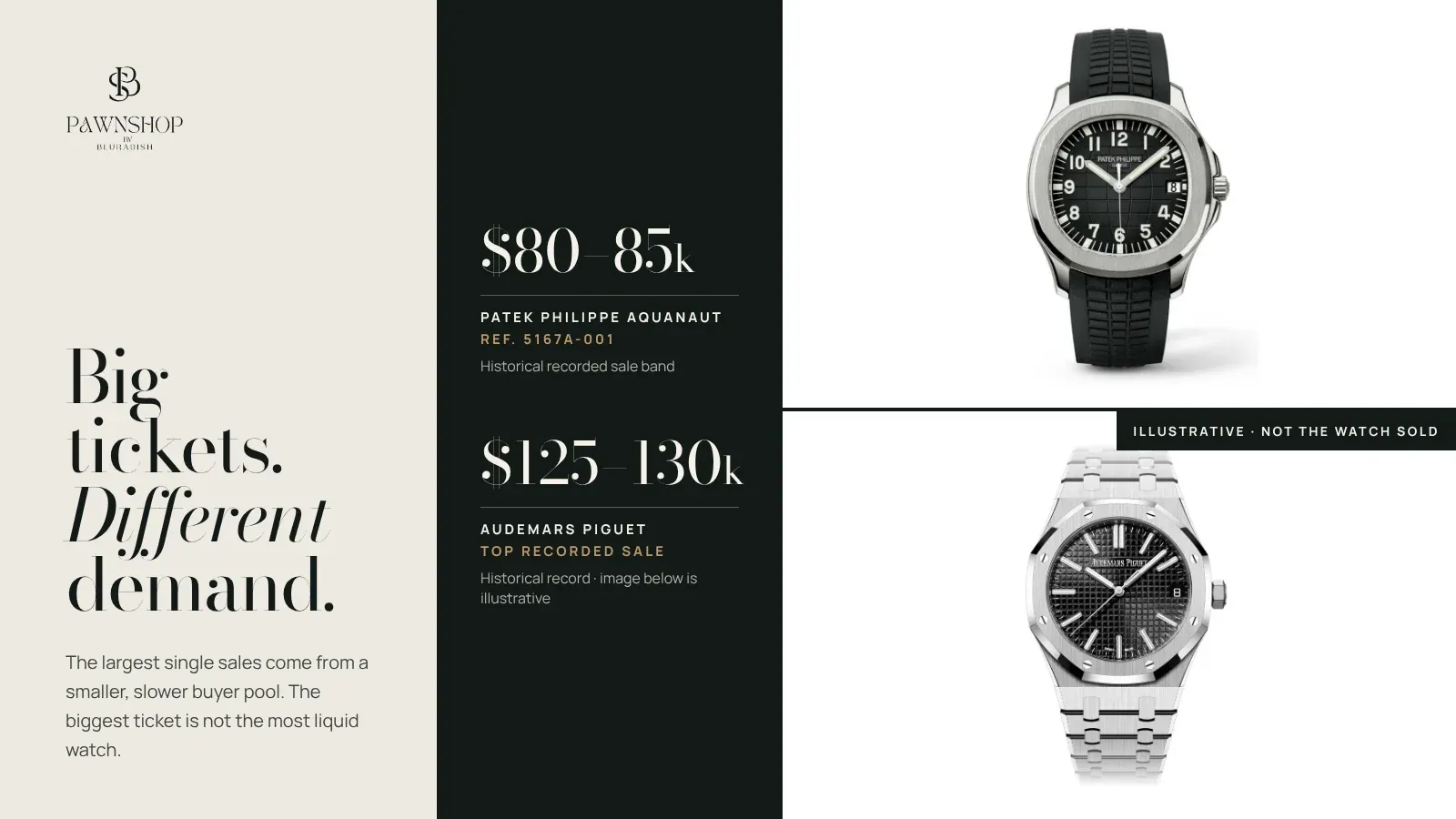
Patek Philippe and Audemars Piguet recorded some of the highest individual transaction values in our history, illustrating the distinction between high-value sales and consistent secondary-market demand. Watch imagery is illustrative.
These are meaningful transaction values. They establish that our market includes buyers willing to spend substantial amounts on high-end watchmaking. But our records contain only 14 Audemars Piguet sales and three identifiable Patek Philippe sales. That is not enough to conclude that either brand is more liquid than Rolex or Cartier in Nigeria.
For a buyer considering a six-figure watch, the important question is not whether a watch has sold for a significant amount before. It is whether the exact reference can be acquired at a certain price, and whether there is enough current demand to support an eventual exit.
What should a buyer actually take away from this?
I would separate the decision into three categories.
The first is someone looking for a watch around $5,000 to $8,000 who wants something desirable, wearable and supported by observable secondary-market demand. Based on our records, selected Cartier Santos configurations, particularly WSSA0030 and WSSA0062, deserve attention.
The second is the buyer comfortable spending approximately $12,000 to $25,000. This is where selected Rolex Datejust references become interesting. Our transaction volume is substantial enough to demonstrate recurring demand, and the range of configurations makes careful selection especially important.
The third is the buyer considering $35,000 to $100,000 or more. Rolex Day-Date, selected Audemars Piguet references and Patek Philippe watches become relevant here, but reference-level valuation matters significantly. Higher transaction values should not be mistaken for easier resale.
There is also a principle that applies to every price category. The price at which you enter a market is just as important as the demand waiting for you when you leave it. A Rolex bought well above its prevailing secondary-market value can produce a disappointing resale outcome even when demand remains strong. Conversely, a carefully sourced watch acquired at a competitive price may offer more protection against depreciation. This is why purchase history, original documentation, condition and independent valuation matter. They are not administrative details to consider after choosing a watch. They are part of the financial decision itself.
A luxury watch can be an asset. That does not make every luxury watch a good investment.
I think this distinction will become increasingly important as more Nigerians begin treating luxury ownership as part of a broader conversation about wealth and liquidity. A watch does not generate income simply by sitting in a safe. Its value can rise or fall. It requires maintenance, authentication and secure storage, and selling it often involves a dealer margin or other transaction costs. Even a highly desirable watch can be difficult to sell at the price its owner expects.
Rolex accounts for the largest share of transaction activity. The Datejust demonstrates recurring demand across a comparatively accessible luxury price range. The Cartier Santos shows particularly encouraging turnover in several documented configurations. The Day-Date and selected high-end pieces demonstrate that substantial capital can be realised through a single luxury-watch transaction.
For a buyer, that is useful information. Because the most financially intelligent luxury purchase is not necessarily the watch with the highest price tag, the rarest dial or the greatest amount of attention online. It is a watch you genuinely want to own, acquired at a sensible price, with enough observable demand that you have a realistic understanding of what might happen when you decide to sell. And that is a far better way to approach a significant purchase than discovering the market for your watch only after you have bought it.
About the data: This analysis draws on Pawnshop by Bluradish's reconciled sales records from October 2023 to August 2026. The dataset covers more than 650 luxury-watch sales with a total transaction value between $7.5 million and $8 million. Reference-level holding periods come from the company's purchase and resale history. The findings reflect transaction patterns at Pawnshop by Bluradish and do not guarantee future resale values.